


Building the Strongest Car Accident Claim in Newport Beach
Key Takeaways: Evidence collected immediately after a Newport Beach car accident determines your claim’s strength. Photographs, witness statements, police reports, and insurance documentation prove fault under California law. California’s pure comparative negligence system allows even partially at-fault victims to recover damages, making thorough preservation of evidence critical. You have two years to file a personal injury lawsuit and three years for property damage claims. Working with an attorney early helps secure evidence before it disappears.
Car accident victims in Newport Beach often ask what separates successful injury claims from those that fail
The answer is evidence. What you document at the scene, in the days that follow, and throughout treatment shapes your ability to prove negligence. Physical evidence fades, memories shift, and insurers minimize payouts. Whether your crash happened on Pacific Coast Highway, Jamboree Road, or near Fashion Island, the proof you gather influences every claim stage.
If you were recently injured in a crash and need guidance, Bisnar Chase can help. Call 800-561-4887 or contact us online for a free consultation.
Scene Evidence: What to Photograph and Why It Matters
The most valuable action at an accident scene is taking photographs. Photos of the scene, property damage, and injuries establish your damages if insurers contest your claim. Take wide-angle shots capturing the overall scene, close-ups of vehicle damage, and images of visible injuries.
Pay close attention to traffic control devices near the collision. Photos, including stop signs, traffic signals, or yield signs, demonstrate who had the right of way. The evidence from the Newport Beach car accident can be decisive when the other driver disputes responsibility.
Document road conditions, skid marks, debris patterns, and weather. These details disappear as roads are cleared. Tire marks tell accident reconstructionists how fast a vehicle traveled or whether a driver braked. Capture everything with your phone camera before leaving.
💡 Pro Tip: Use your phone’s video mode for a slow 360-degree walkaround of the entire scene. Video captures details you might miss in photos, including background traffic patterns and lighting conditions difficult to recreate later.
Why the Police Report Carries Significant Weight
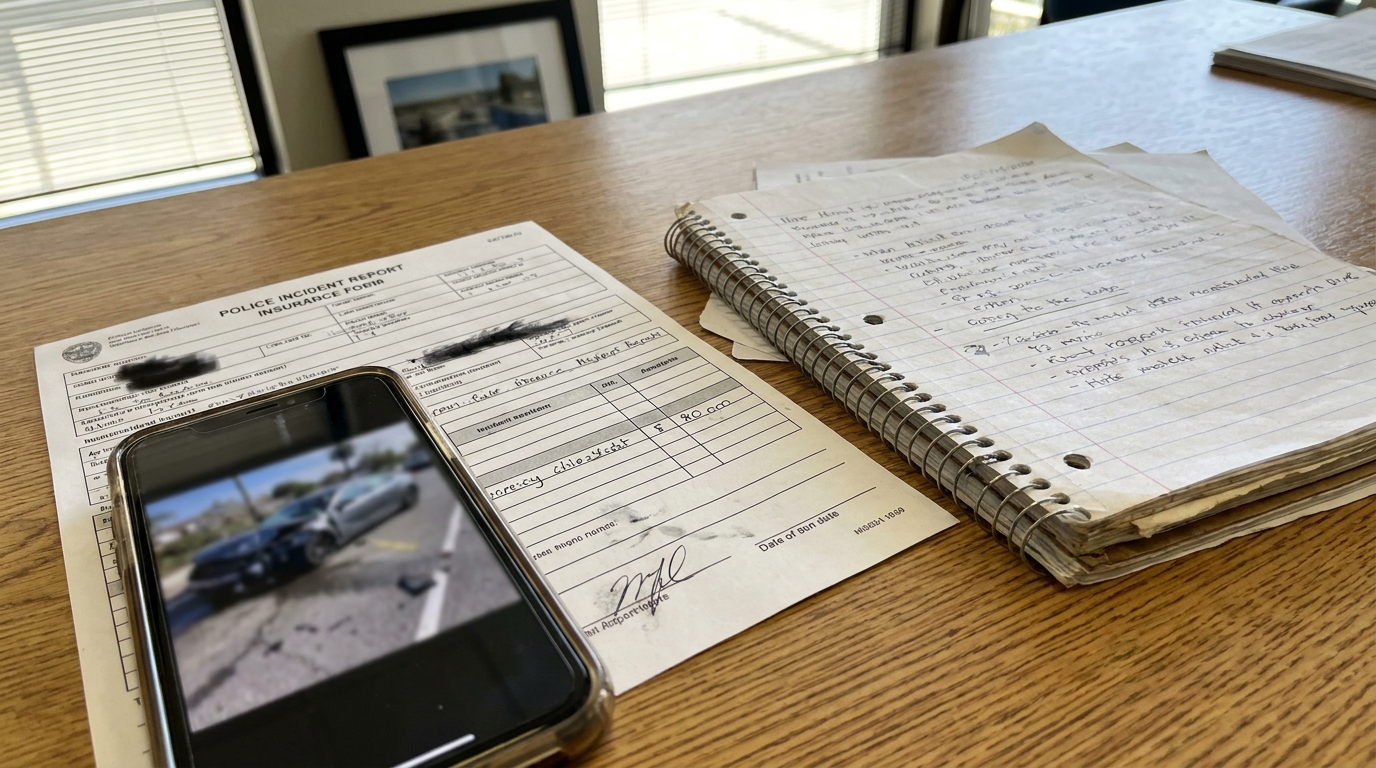
Always call law enforcement, even if the collision seems minor. The responding officer investigates, interviews drivers and witnesses, and generates an official report containing their fault assessment. While not conclusive in civil lawsuits, this determination persuades insurance adjusters and juries.
The police report creates a contemporaneous record of what both drivers said at the scene. If the other driver later changes their story, the report locks in their original statements. Inconsistencies between scene statements and later claims can seriously damage their credibility.
Requesting and Using Your Report
You can typically obtain your Newport Beach police report within days of the collision. Review it carefully for accuracy. If the report contains errors, your attorney can help address discrepancies. The report serves as a foundational document that your legal team references throughout the claims process.
💡 Pro Tip: The other driver’s SR-1 report filed with the DMV may reveal inconsistencies with their police or insurer statements. Your attorney can request this document to strengthen your position.
Witness Testimony and Contact Information
Independent witness testimony is one of the most powerful forms of car crash evidence. Bystanders who saw the collision have no personal stake in the outcome, making their accounts particularly credible. These witnesses may confirm that the other driver was at fault or contradict the other driver’s version of events.
Collect names, phone numbers, and email addresses from anyone who stopped or observed the crash. Memories fade quickly, and witnesses become harder to locate over time. If you’re too injured to gather this information, ask a passenger, bystander, or responding officer to help.
What Makes Witness Accounts So Valuable
A witness can describe details neither driver noticed. For example, a pedestrian may have seen the other driver looking at their phone before running a red light. That testimony directly supports a negligence claim and can shift settlement negotiations.
Exchanging Information and Documenting the Other Driver
California law requires drivers to stop at accident scenes and exchange identifying and insurance information. This is both a legal obligation under California Vehicle Code §§16025 and 20003, 20004, and a practical necessity for building your claim. Record the other driver’s name, phone number, insurance company, policy number, driver’s license number, and license plate number.
Documenting the license plate is critical if they attempt to flee. In hit-and-run situations, the plate number enables police to identify the vehicle and driver. If the other driver leaves, photograph the plate immediately and call 911.
For a detailed walkthrough of immediate post-crash steps, review our guide on what to do after a car accident in Orange County.
💡 Pro Tip: Never admit fault or apologize at the scene, even casually. Statements like “I’m sorry” or “I didn’t see you” can be used against you by the other driver’s insurer to argue comparative negligence.
How California’s Comparative Negligence Rules Affect Your Claim
California follows pure comparative negligence, meaning you can recover damages even if partially at fault. Courts apportion fault among all parties and reduce your recovery by the percentage of your responsibility. If you’re found 20 percent at fault and your total damages are $100,000, you recover $80,000. This framework makes strong evidence of the other party’s negligence critical to maximizing recovery.
Proving fault in a car accident in California requires thorough documentation. Every photograph, witness statement, and medical record pointing to the other driver’s negligence increases their fault percentage and your potential recovery.
Proposition 51 and Multi-Party Accidents
When multiple parties share fault, California Civil Code §1431.2 adds an important distinction. Under Proposition 51, each defendant is liable only for non-economic damages (pain and suffering, emotional distress) in proportion to their fault percentage. However, economic damages like medical bills, lost wages, and property repair costs remain subject to joint and several liability under §1431, meaning you may recover the full amount from any at-fault defendant regardless of their individual share. This underscores the importance of documenting all economic losses with receipts, billing records, and wage statements.
| Damage Type | Liability Rule | What It Means for You |
|---|---|---|
| Economic (medical bills, lost wages, property damage) | Joint and several (Cal. Civ. Code §1431) | You may recover the full amount from any at-fault defendant |
| Non-economic (pain and suffering, emotional distress) | Several only (Cal. Civ. Code §1431.2) | Each defendant pays only their proportional share |
Insurance Documentation and Uninsured Motorist Coverage
Your own insurance policy may be just as important as the at-fault driver’s coverage. If the other driver carries no insurance or insufficient coverage, your uninsured/underinsured motorist (UM/UIM) policy allows you to file a claim against your own insurer. This is common in Newport Beach and throughout Orange County, highlighting why understanding your car accident insurance options matters.
Keep every document related to your accident organized from day one. This includes medical bills, pharmacy receipts, physical therapy records, repair estimates, rental car invoices, and documentation of missed work. Each record supports your claim for economic damages and strengthens your position during settlement negotiations or at trial.
💡 Pro Tip: Request itemized billing statements from every medical provider rather than summary invoices. Itemized records connect specific treatments to your accident injuries, making it harder for insurers to argue charges are unrelated.
Deadlines That Can Make or Break Your Newport Beach Claim
California imposes strict deadlines for filing personal injury and property damage lawsuits, and missing them can permanently bar your claim. The statute of limitations for personal injury claims is two years from the injury date under Code of Civil Procedure §335.1. Property damage claims carry a three-year deadline under Code of Civil Procedure §338.
If your accident involved a government entity, such as a city vehicle or dangerous road condition, significantly shorter deadlines apply. Under the California Government Claims Act, you must file an administrative claim with the responsible agency within six months before filing a lawsuit. Courts interpret tolling exceptions narrowly, so consult an attorney promptly.
Protecting Your Claim With a Personal Injury Attorney in Newport Beach CA
The sooner you involve an attorney, the more evidence you preserve. A personal injury attorney in Newport Beach can send spoliation letters to prevent the other driver’s insurer from destroying vehicle data, obtain surveillance footage before it’s recorded over, and coordinate with accident reconstruction professionals. Early legal involvement protects critical evidence.
💡 Pro Tip: Many traffic cameras, dashcams, and business surveillance systems overwrite footage within 30 to 90 days. If a nearby camera may have captured your crash, notify your attorney immediately to request preservation.
Frequently Asked Questions
1. What is the most important evidence in a Newport Beach car accident claim?
Photographs of the scene, vehicle damage, and injuries are most critical because they create a permanent visual record supporting your version of events. Combined with police reports and witness statements, photos form the foundation of proving fault and damages.
2. Can I still recover compensation if I was partially at fault for my car accident in California?
Yes. California’s pure comparative negligence system allows you to recover damages even if you bear the majority fault. Your total recovery is reduced by your responsibility percentage, which is why documenting the other driver’s negligence is important.
3. How long do I have to file a car accident lawsuit in California?
You have two years from the injury date to file a personal injury lawsuit and three years for property damage. Claims involving government agencies must be filed as an administrative claim within six months. Consult an attorney promptly to confirm your deadline.
4. What should I do if the other driver fled the scene of the accident?
Photograph their license plate immediately and call 911. The plate number enables police to identify the driver, and you may still have options through your uninsured motorist coverage. Report the hit-and-run to your insurer as soon as possible.
5. Why does the police report matter if it is not legally binding?
While not conclusive in court, the officer’s fault assessment is persuasive to insurance adjusters and juries. The report also preserves the other driver’s initial statements, which can challenge any later inconsistencies in their account.
Take Action to Protect Your Newport Beach Car Accident Claim
Strong evidence does not collect itself, and every day after a collision makes it harder to obtain critical proof. From photographing the scene and gathering witness information to understanding how California’s comparative negligence rules affect your recovery, the steps you take now shape your claim’s outcome.
Reach out to our Newport Beach personal injury attorneys at Bisnar Chase to discuss the evidence in your case. Call 800-561-4887 or contact us today for a free consultation.