


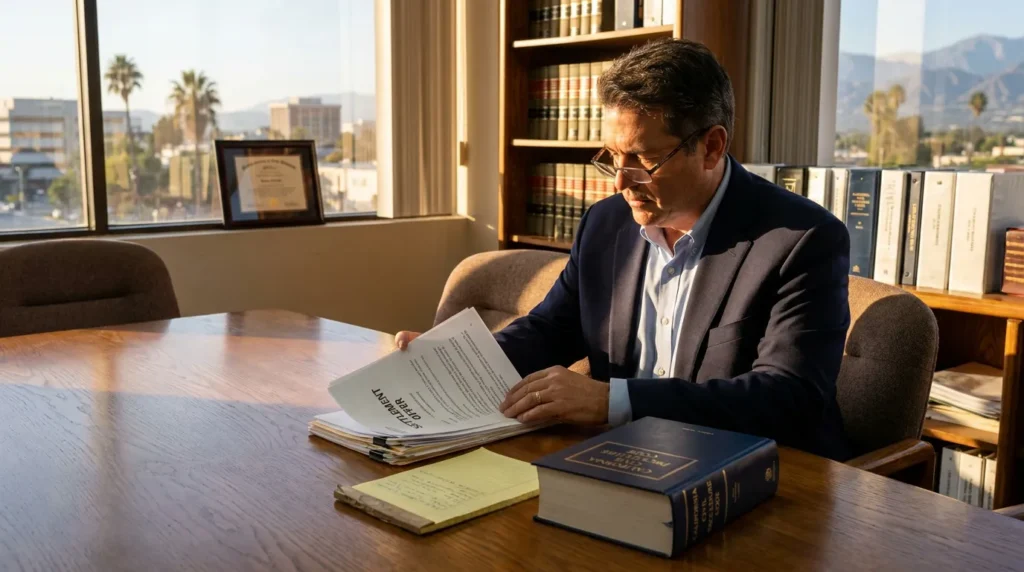
The Settlement Tool That Can Change the Math in Your San Bernardino Injury Case
Key Takeaways: A CCP 998 offer to compromise is a formal statutory settlement offer under Cal. Code Civ. Proc. § 998 that either party can serve before trial in a California personal injury case. Its power lies in cost-shifting: a party that rejects a valid offer and fails to do better at trial may lose its own post-offer costs and pay the other side’s post-offer costs and, potentially, expert witness fees.
A plaintiff who beats their rejected offer may recover prejudgment interest under Civ. Code § 3291, while a plaintiff who rejects a defense offer and fails to obtain a more favorable judgment faces consequences under § 998, subd. (c)(1). To be valid, an offer must be in writing, certain in its terms, made in good faith, include an acceptance provision, and be served within statutory windows, generally no later than 10 days before trial, with 30 days to accept. California’s rule is broader than Federal Rule 68 because either side may make an offer and expert fees may be awarded.
A CCP 998 offer to compromise is a formal, statutory settlement offer that either side can serve before trial in a California personal injury lawsuit, and its defining feature is a cost-shifting penalty. If a party rejects a valid 998 offer and then fails to obtain a more favorable judgment at trial, that party may lose its own post-offer costs and be ordered to pay the other side’s post-offer costs. Codified at Cal. Code Civ. Proc. § 998, this rule can create real financial pressure on an insurance carrier that refuses to pay fair value on a San Bernardino car accident claim.
If you were injured in a collision and an adjuster is stalling, the team at Bisnar Chase can help you understand where a 998 settlement offer fits into your case. Call 800-561-4887 for a free consultation or contact us now to discuss your options.
Why Code of Civil Procedure 998 Exists
The statute has one central purpose: encouraging settlement before trial. In Martinez v. Brownco Construction Co. (2013) 56 Cal.4th 1014, the California Supreme Court explained that section 998 “was enacted to encourage the settlement of lawsuits prior to trial” by adjusting recoverable costs based on pretrial settlement conduct. The Legislature’s chosen lever is money, not persuasion.
A 998 offer is not a demand letter or informal negotiation with a claims adjuster. It is a procedural device with statutory consequences, which is why timing and wording deserve careful attention from counsel.
How the Cost-Shifting Mechanics Actually Work
The leverage in a 998 offer often comes from expert witness fees and costs. Under ordinary California cost rules (Code Civ. Proc. §§ 1032, 1033.5, subd. (b)(1)), expert fees are generally not recoverable. Section 998 may change that default.
If a plaintiff serves a 998 offer, the defendant rejects it, and the defendant fails to obtain a more favorable judgment, the court may in its discretion order the defendant to pay the plaintiff’s reasonable post-offer expert witness costs (§ 998, subd. (d)). Discretion is key, the court is not required to make that award, and any amount must be reasonable.
The rule runs harder in the opposite direction. Under § 998, subd. (c)(1), a plaintiff who rejects a defense offer and fails to obtain a more favorable judgment generally may not recover post-offer costs and must pay the defendant’s costs from the offer date; additionally, the court may order the plaintiff to pay the defendant’s reasonable expert witness costs, but only for fees incurred after the date of the offer (post-offer costs only), pursuant to the 2015 amendment to CCP § 998 effective January 1, 2016. The California Supreme Court discussed the prior framework for expert witness cost exposure in Regency Outdoor Advertising v. City of Los Angeles (2006) 39 Cal.4th 507, 532.
Prejudgment Interest as a Second Layer
Beating your own rejected 998 offer may also trigger prejudgment interest. In personal injury actions, Cal. Civ. Code § 3291 provides that a plaintiff who obtains a judgment more favorable than their rejected offer may recover interest on damages from the offer date. This does not apply to punitive damages or actions against public entities. Over a multi-year case, that interest can be substantial.
Combined with expert fee awards, a well-timed offer may meaningfully increase total recovery when a defendant unreasonably refuses to settle. These outcomes remain fact-dependent, and courts retain discretion.
What the Numbers Can Look Like
Reported decisions show how large 998 exposure can become. In Martinez, the injured plaintiff’s judgment was $1,646,674 and the spouse’s was $250,000, with roughly $561,000 in claimed costs and $188,536.86 in disputed expert fees falling between two offers. The court held that where a plaintiff serves two unaccepted offers and the defendant fails to obtain a more favorable judgment, the trial court may award expert costs from the first offer date.
That holding is narrow but practically important: multiple offers are permitted, and an early reasonable offer may anchor the cost-shifting clock. The underlying California Supreme Court decision on 998 offers remains a key authority.
Timing, Format, and Validity of a 998 Settlement Offer
A 998 offer must be in writing, satisfy statutory requirements, and be served within the statutory window. Under § 998, subd. (b), an offer may be made up to 10 days before trial or arbitration. The offer is deemed withdrawn if not accepted within 30 days or before trial starts, whichever comes first (§ 998, subd. (b)(2)). If accepted, either party may file the offer and acceptance, and the court enters judgment accordingly.
Validity is where offers frequently fail. To be enforceable, an offer must state terms with sufficient certainty, be made in good faith, and contain a provision allowing acceptance by signing a statement of acceptance. A defective offer will not trigger cost-shifting benefits.
- Certainty: terms must be clear enough for a court to enter judgment
- Good faith: token or unrealistic figures may be disregarded
- Acceptance provision: the offeree must have a stated way to accept
💡 Pro Tip: Ask your attorney to calendar the 30-day acceptance window and the 10-day pre-trial cutoff separately. Missing either can erase leverage you already earned.
Using a CCP 998 Offer to Compromise Strategically
Section 998 is a two-way tool, and both sides in Inland Empire litigation are aware of it. Plaintiffs may use offers to pressure carriers toward fair numbers by raising the prospect of added expert fees and interest. Defendants may use them to cap exposure when they believe a claim is overvalued. What controls is whether the offer was reasonable when served and how it compares to the eventual judgment.
Deciding whether to accept a defense offer is one of the harder calls in any car accident settlement San Bernardino victims face. It requires honest valuation of damages, liability risk, and California’s pure comparative fault rule. That analysis is fact-specific and belongs in a conversation with your attorney.
How Section 998 Compares to Federal Rule 68
California’s version is broader than its federal counterpart. Under Federal Rule of Civil Procedure 68, only “a party defending against a claim may serve” an offer, and it must be served at least 14 days before trial. Section 998 allows either side to make an offer.
| Feature | Cal. Code Civ. Proc. § 998 | Fed. R. Civ. P. 68 |
|---|---|---|
| Who may offer | Either party | Defending party only |
| Deadline to serve | Generally 10 days before trial | At least 14 days before trial |
| Expert fees | Court may award in its discretion | Not provided by the rule |
Deadlines That Control Whether a 998 Offer Ever Matters
A 998 offer only has force inside an active or reasonably anticipated lawsuit. In California, a personal injury claim from a car crash must generally be filed within two years of injury (Code Civ. Proc. § 335.1), while property damage claims carry a three-year deadline (Code Civ. Proc. § 338).
Exceptions such as tolling exist but courts apply them narrowly. Claims against public entities require a written claim presented to the entity first, typically within six months under the Government Claims Act. Confirming your deadlines early with a San Bernardino injury lawyer is the safest course.
Frequently Asked Questions
1. Do I have to accept a 998 offer from the insurance company?
No. If you reject a valid offer and fail to obtain a more favorable judgment, however, you generally lose your post-offer costs and must pay defense costs from the offer date, and the court may order you to pay defense expert witness costs under § 998, subd. (c)(1).
2. Can my attorney serve more than one 998 offer?
Yes. Multiple offers are permitted, and Martinez v. Brownco confirmed that a court may award expert costs dating back to the first unaccepted offer rather than only the last one.
3. What makes a 998 offer invalid?
Common problems include vague terms, amounts that appear not to be good-faith settlement attempts, and absence of the required acceptance provision. Courts evaluate validity case by case.
4. Does a 998 offer expire?
Yes. The offer is deemed withdrawn if not accepted within 30 days or before trial begins, whichever occurs first. An offer may also be revoked earlier by the offering party in writing before acceptance.
5. Should I make a 998 offer if my case seems small?
That depends on the facts. Cost-shifting exposure can matter in modest cases too, but the analysis turns on damages evidence, liability, and litigation posture. Discuss it with counsel before serving anything.
Putting Section 998 to Work in Your Case
A CCP 998 offer to compromise is one of the few procedural tools that may let an injury victim impose real financial consequences on a carrier that will not negotiate reasonably. Used correctly, it can potentially support fair resolution before trial and, in some cases, expand recovery through expert fees and prejudgment interest. Used carelessly or drafted improperly, it may create exposure instead. Outcomes always depend on the specific facts.
If you have questions about a ccp 998 offer to compromise lawyer review of your collision claim, Bisnar Chase is ready to listen. Call 800-561-4887 or reach out to our team today. Call us today for a free consultation.
Disclaimer: This content is for informational purposes only and is not legal advice. Every case is unique, and results may vary. Consult an attorney about your specific circumstances.