



Amazon has become the world’s largest online marketplace in recent years. But what happens when you buy a dangerous product from Amazon that malfunctions and causes an injury? When that happens, you have legal options.
In this blog, we explore the laws around online purchases, third-party products sold on Amazon, and some of the most serious defective product accidents and lawsuits. We also cover the landmark cases that forced Amazon to take accountability.
If you need a lawyer, Bisnar Chase is a top-rated personal injury law firm based in California. We have a 99% success rate with over $1 billion recovered for our clients, including major product liability victories. You can contact us for a free consultation.
Dangerous Products on Amazon
Most products sold on Amazon are not dangerous and function exactly as they should when used as intended. But with the massive volume of items sold on the platform, including many by third-party sellers, it is no surprise that some are faulty, malfunction, or cause injuries.
The term ‘dangerous product’ covers a wide range of situations. It can refer to any consumer item sold on Amazon that carries a risk to the buyer or user.
There are plenty of potential reasons why a product could be dangerous.
- It was poorly designed and carries inherent issues or dangers in every unit.
- There were issues in the manufacturing process, with cheap materials or poor processes resulting in issues.
- Failing to warn consumers about dangers or potential risks, or failing to provide instructions or age limits. This can increase the risk of an accident caused by use.
- The product or specific components malfunction, bringing unforeseen dangers.
As a consumer, you have the right to expect that any products you buy are safe when used as directed or expected. But that is not always the case.
Can You Take Legal Action Against Amazon Over a Dangerous Product?
Yes, in many cases, Amazon is responsible for dangerous products sold on its website or app and could be liable for any injuries sustained.
The issue of legal liability has always been murky because many of the products on Amazon.com come from third-party sellers who use Amazon as their distribution platform.
Initially, Amazon escaped liability by claiming it was just the middleman in the transaction. However, recent court rulings have placed more responsibility on the shoulders of the e-commerce giant, giving injured consumers a clearer path to compensation.
The History of Amazon
Founder Jeff Bezos created Amazon in his Seattle garage in 1994. Bezos was working in finance when he put his electrical engineering and computer science degrees to good use. He spotted the potential of the internet and came up with an online marketplace.
Originally conceived as an online bookshop with a vast catalogue, Amazon.com was officially launched in 1995 and went public in 1997.
It quickly moved beyond just selling books. In 1998, Amazon added music, videos, and computer games. By 2000, it had transformed into an ‘everything store’ and allowed third-party sellers to list their goods.
Innovation and Expansion
In the years since, Amazon has started creating its own products, such as the Amazon Echo smart speaker, Alexa AI, Kindle e-books, and the Amazon Basics range. The company moved into grocery sales by acquiring Whole Foods in 2017, as well as launching a streaming platform.
The invention of Amazon Prime – a subscription that allows for superfast delivery times and free shipping on most products – combined with the vast range of available products, has revolutionized digital retail and changed the way many people shop.
As of August 2025, Amazon.com Inc. had a market cap value of $2.41 trillion, while Jeff Bezos is one of the richest people in the world, with a net worth of over $240 billion.
Defective Products Sold on Amazon: Who Is Liable?
The products listed on Amazon can be divided into two columns: products produced and sold by Amazon and products by other companies (known as third-party sellers) that are sold on the Amazon.com platform.
Third-Party Products on Amazon
Amazon sells many of its own products on its platform. The following is an example of a Kindle e-reader that is produced and sold by Amazon. The highlighted product details in the bottom-right corner show that it is sold and distributed by Amazon.
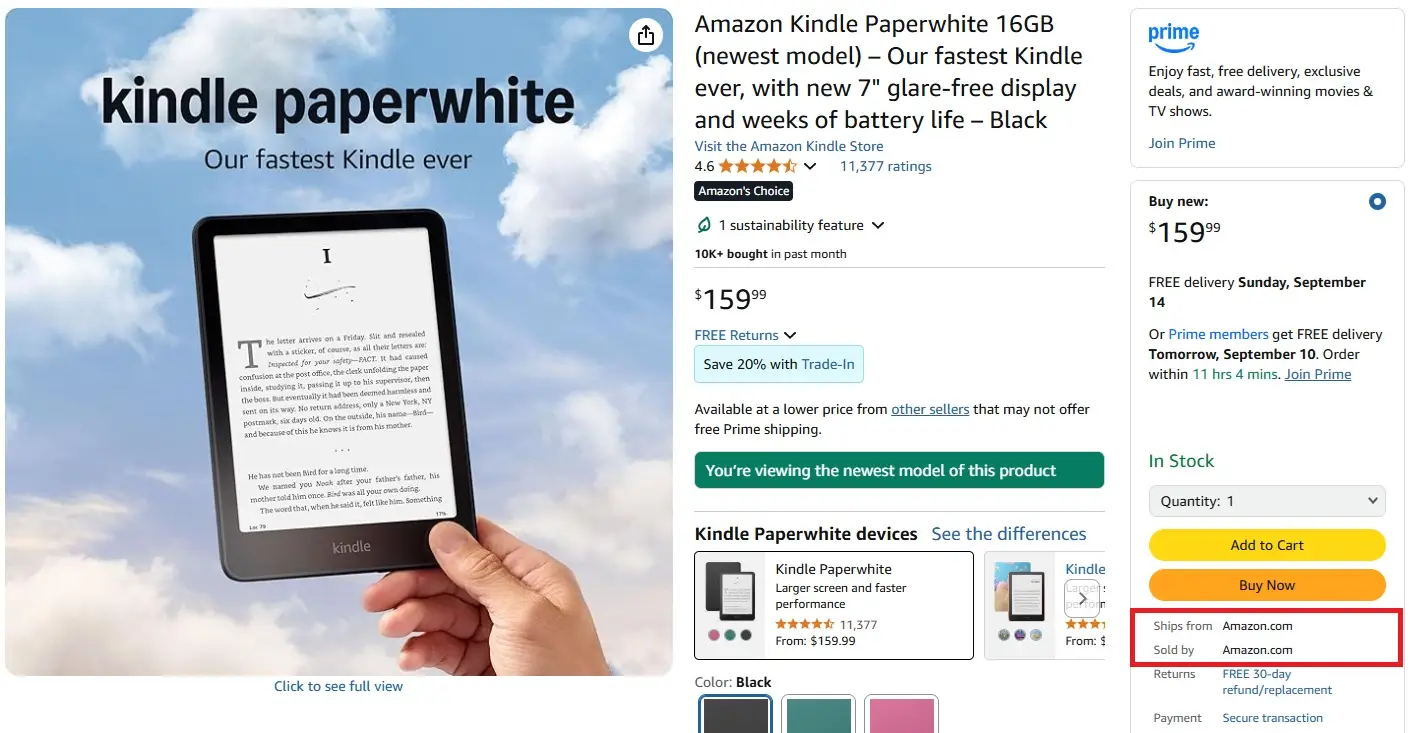
The platform also sells products listed by other companies, which are referred to as third-party products.
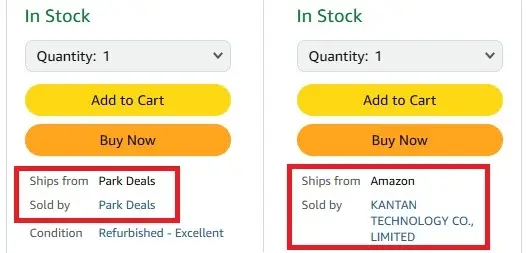
The listing tells you if a product is sold by a third party. It will feature a ‘Sold By’ line under the product as part of the description. This will say “Amazon” if Amazon produces the product. If not, it will have the name of the manufacturer/distributor responsible for the product.
A listing might also feature an FBA badge. FBA stands for ‘Fulfilled by Amazon’ and refers to a service allowing third-party companies to store their products at an Amazon facility. Amazon is then responsible for sending out orders for third-party products.
The image below shows the different listing options, demonstrating how to tell who is selling the product and where it is being shipped by Amazon or the third party.
Legal Liability with Amazon
When a faulty product is produced and sold by Amazon, the issue of liability is obvious. But when it is a third-party product sold on the Amazon platform, things become a little more interesting.
In such cases, multiple parties can share liability. The original company that designed, ordered, or manufactured the product is still responsible for its safety. But as a key part of the transaction and chain of distribution, Amazon is also liable.
In most cases, Amazon has the deeper pockets and will be targeted in a lawsuit whenever possible. But we firmly believe in holding all responsible parties accountable for their part in delivering dangerous items to consumers.
Pivotal Court Cases That Set the Amazon Precedent
Several key court cases have been used to determine legal liability for dangerous products sold on Amazon.
In its terms of use, the company first stated that third-party sellers were responsible for their goods, absolving Amazon of any blame for accidents and injuries involving those products.
But that position was eventually challenged in the courts. A couple of the key decisions include:
Bolger v. Amazon (2020)
Bolger v. Amazon was a groundbreaking case that changed the way e-commerce product liability cases are handled.
Plaintiff Angela Bolger bought a laptop battery on Amazon. The seller was identified on the listing as E-Life – a name used by a manufacturer called Lenoge Technology.
Amazon completed the sale of the battery, charging the plaintiff, retrieving the item from its storage location in an Amazon warehouse, and packaging and delivering the item.
But several months later, the battery exploded, and Angela Bolger sustained severe burn injuries. The following steps show how legal proceedings played out:
- Bolger filed a product liability lawsuit against Amazon and Lenoge.
- Lenoge was served but did not appear to answer the case, and a default judgment was entered against the company.
- Amazon denied any liability, claiming that it was just an online marketplace and did not manufacture, distribute, or sell the item.
- The California court sided with Amazon and dismissed the case.
- However, Bolger filed an appeal with the California Court of Appeals, arguing that Amazon was strictly liable for defective products offered on its site.
- The Court of Appeals agreed and reversed the decision. It ruled that Amazon placed itself between the consumer and the producer in the distribution chain and is liable if a product sold through its website is defective.
This appeal decision set a new precedent for cases involving dangerous and defective products sold on Amazon.
Loomis v. Amazon (2021)
Shortly after the Bolger decision, the courts used their new precedent in another dangerous product injury case.
Plaintiff Kisha Loomis filed a lawsuit against Amazon after suffering injuries from an allegedly defective hoverboard, which was sold by a third-party company based in China under the listing name TurnUpUp.
The hoverboard was a Christmas gift. But it quickly caught fire while plugged in for charging. The victim sustained burn injuries while putting out the fire.
- A lawsuit was filed against Forrinx (the seller) and Amazon, alleging product liability, negligence, and breach of warranty.
- As in the Bolger case, a California court initially sided with Amazon through a summary judgment.
- Once again, the decision was reversed on appeal, with the courts applying the new precedent set in Bolger v. Amazon.
- The court concluded that Amazon is a key link in the vertical chain of distribution under California’s strict liability laws. Amazon took the payment, transmitted the order to the seller for distribution, and took care of all communication with the consumer. They were also paid a percentage of the sale.
Amazon’s Argument Against Liability
In the trend-setting California cases, Amazon attempted to argue the decision by quoting some previous decisions issued by courts in other states. They include:
- Erie Ins. Co. v. Amazon (Maryland): A malfunctioning headlamp caused a house fire. The Fourth Circuit Court decided Amazon was not liable as a seller because it never held the title to the goods in question.
- Stiner v. Amazon (Ohio): A teen died after taking pure caffeine powder purchased on Amazon. The Ohio Supreme Court ruled that Amazon could not be held liable as a supplier, as it never possessed or controlled the product.
- Fox v. Amazon (Tennessee): This was another defective hoverboard fire case. It was initially dismissed, but on appeal, the court ruled that Amazon was liable for failing to warn customers of the dangers. It was resolved with a confidential settlement before trial.
- Milo & Gabby LLC v. Amazon (federal court): A company that makes pillowcases sued Amazon for patent and copyright infringement in third-party products. But a court found no liability under the Digital Millennium Copyright Act because Amazon was not the seller.
But these arguments were rejected in California. The courts stated that they did not have to rely on opinions from further afield when extensive analysis has confirmed that Amazon is liable under California’s strict liability laws.
It should also be noted that cases nationwide have gone both ways. In Oberdorf v. Amazon, a woman was blinded in one eye when a defective dog collar broke, causing the leash to snap back and damage her eye. In that case, as in California, a Pennsylvania appeals court ruled that Amazon was liable.
The CPSC Decision with Amazon
In 2024, the U.S. Consumer Product Safety Commission (CPSC) released a decision that had a major impact on Amazon’s responsibilities.
A unanimous vote by the CPSC determined that Amazon is officially a distributor of third-party products. This decision means that Amazon is legally responsible for these products when they are defective or fail to meet safety standards.
The CPSC ordered Amazon to notify consumers about dangerous products, remove listings, and incentivize the return or destruction of the dangerous products. This decision was another step toward ensuring that Amazon was held legally accountable for any dangerous products sold on its platform.
Should Amazon Be Liable?
There are two schools of thought, and we have seen both avenues discussed extensively by courts across the United States.
On the one hand, some people might say that Amazon has not done anything wrong. Most of the time, Amazon was not aware of a defect beforehand and should not bear responsibility for any resulting damage.
However, we could also argue that Amazon has a duty to know what is being sold on its site and legitimized by the Amazon name and reputation. It should at least have some knowledge of whether these products are safe, and the company is negligent in facilitating the sales of these products without any care or knowledge of their quality or safety.
Why Court Rulings Against Amazon Are Important
There was a time not long ago when most courts in the United States agreed that Amazon was not a traditional seller under the common understanding of the term, allowing them to escape liability.
However, times are changing. Beneath the massive growth of internet-based sales, it has become clear that Amazon is a critical link in the distribution chain between the supplier and consumer.
In the Bolger case, the court specifically stated that Amazon played a more meaningful role in the transaction than the other defendants and rejected Amazon’s arguments to the contrary.
This ruling is significant because it sets a precedent for all other California courts to follow in future cases. In addition, many third-party sellers on Amazon are based abroad in different countries, which often protects them from court judgments and leaves injury victims with no avenue of compensation.
Making Amazon accountable for the goods sold on its platform both improves safety standards and protects consumers in the event of an accident or injury.
Types of Accidents and Injuries Involving Amazon Products
When you sell the range of products that Amazon does, there is plenty of potential for accidents and injuries. In an ideal world, all consumables would work exactly as intended.
But as renowned product liability lawyers, we have seen countless cases involving dangerous products and malfunctions.
Amazon has tons of different product categories and subcategories. The most popular include books, electronics, home and kitchen, clothing, beauty and personal care, sports and outdoors, toys and games, tools, pet supplies, baby care, and automotive. Of course, you aren’t likely to get many injuries from books sold by Amazon. But some of the items in these categories have caused significant injuries.
Potential Product Accidents
The following are just some of the potential dangers linked to products sold on Amazon and elsewhere, referring to examples of product dangers rather than specific incidents:
- Items with lithium-ion batteries that explode and cause fires or burns.
- Electronic devices that malfunction or do not have shock protection.
- Clothing and other products made from materials that do not meet flammability and other safety guidance.
- Toys and games with choking hazards.
- Faulty carbon monoxide detectors and other vital alarms.
- Unstable furniture with tip risks.
- Power tools, cleaning products, and other high-risk items without clear instructions on use or warnings of dangers.
- Contaminated food.
At Bisnar Chase, our team has handled product liability claims involving a wide range of products carrying significant risks. If you have been impacted by a dangerous product that is not listed above, get in touch with us to find out if you have a case.
Amazon Stats
Amazon is the largest e-commerce marketplace in the world. It has about 600 million products listed on the site, and consumers spend hundreds of billions of dollars on the site every year.
- About 12 million items on the platform are sold by Amazon itself.
- The rest – over 90% – are products from third-party sellers.
- As of 2025, Amazon has nearly 10 million registered sellers, of which about 2 million are active.
- While foreign e-commerce platforms like Temu are quickly gaining a foothold in the global market, Amazon still leads the way.
- Even at this stage, Amazon had year-on-year growth of 13% from 2024 to 2025.
- Over 250 million people are subscribed to Amazon Prime.
- More than 20 orders are placed on Amazon every second, with 1.6 million packages shipped every day.
- These numbers are still on the rise. In fact, Amazon Prime Day has now overtaken Black Friday in terms of online sales.
- Amazon holds nearly 40% of the e-commerce marketplace in the United States. The next highest share is Walmart with 6.4%.
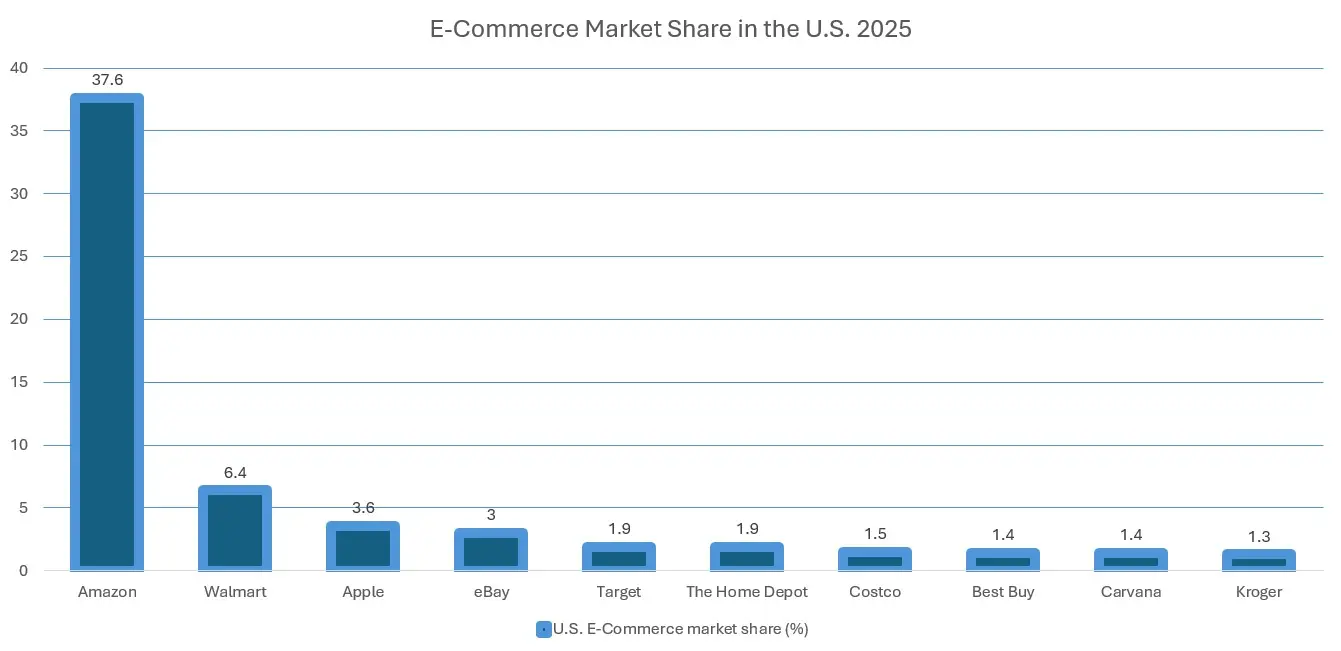
This graph uses statistics from Statista to illustrate Amazon’s market dominance in e-commerce. It includes only online sales, not overall retail.
Why Do So Many Accidents Involve Amazon Products?
We see many recalls of dangerous products sold on Amazon, resulting in lawsuits filed against the company. But why are there so many issues when Amazon is a giant company with the resources to get things right?
One of the main reasons is the sheer volume of products sold on Amazon. With over 600 million listings on the platform, even if only 0.1% of those products had issues, that would be 600,000 unique products carrying potential dangers.
The other main issue is that the quantity of third-party sellers makes it almost impossible to vet them all. With about 2 million unique third-party sellers responsible for over 500 million listings, it is an uphill battle to ensure safety standards prior to sale.
The Process for People to Sell on Amazon
Selling items on Amazon is very easy. The site walks you through the setup steps, which include:
- Creating a seller account.
- Choosing a plan (paying a flat fee of $39.99 per month for sellers with high expected sales or $0.99 per sale for smaller sellers).
- Adding your brand to the Amazon Brand Registry.
- Filling in information about the product to populate the listing.
- Pricing your product and choosing a fulfillment method (whether you want to handle sales yourself or send the products to Amazon to store and ship).
Amazon’s seller guide page informs sellers to ensure their products are safe and compliant. This page provides links to product safety guides, restricted products, suspended products, and product types that require compliance.
For example, dietary supplements are restricted, while other products (such as baby cribs and high chairs) are on the compliance list. This might flag known issues and require extra scrutiny, but it does not prevent listings.
Amazon’s Injury Guarantee
Amazon has an A-to-Z Guarantee for Property Damage and Personal Injury. This guarantee allows injury victims to file claims separate from formal legal proceedings.
When consumers purchase an item on Amazon.com, they have 90 days to report an injury or property damage. Victims can submit a request for a refund or compensation through their Amazon account, along with supporting evidence.
The maximum you can claim through this guarantee is the product purchase price plus up to $1 million toward property damage, medical expenses, and lost wages.
However, we advise any injury victim to contact an attorney at Bisnar Chase for a free consultation before doing anything else. Amazon’s personal injury guarantee is restrictive and may not provide full compensation for your damages.
A qualified legal team will assess your case and ensure you are taking the correct option.
Contact Top-Rated Product Liability Lawyers at Bisnar Chase
If you have sustained an injury due to a product bought on Amazon, you need a top-rated California product liability lawyer on your side. The right attorney will ensure you get the compensation you deserve.
Bisnar Chase has a national reputation for winning dangerous product cases and maximizing compensation for our clients. We handle everything from poor design to faulty manufacturing and failure to warn cases.
We fight for factors including:
- Medical expenses.
- Lost wages.
- Property damage.
- Potential future medical expenses.
- Compromised quality of life.
- Punitive damages.
California courts are clear that Amazon is a part of the distribution process. The Amazon name carries weight, and when a product bought on the platform causes injuries, we are here to hold all liable parties accountable and make our clients whole.
You can contact us for a free consultation with no obligations to find out if you have a case. Get in touch and see what we can do for you.

Brian Chase
Articles, blogs, and content have been reviewed by legal in-house staff. Brian Chase is the managing partner of Bisnar Chase Personal Injury Attorneys, LLP. He is the lead trial lawyer and oversees cases handling dangerous and defective products that injure consumers. Brian is a top-rated injury attorney with numerous legal honors and awards for his work relating to auto defects and dangerous products. His firm has recovered over $1B for its clients. Brian is a frequent speaker for CAOC, Dordick Trial College, and OCTLA, covering personal injury trial techniques.